Sunday, February 2, 2025

Maeda Yoshihiko 油画師 Sensei - 広島市

Maeda Yoshihiko 油画師 Sensei - 広島市

These five postal cards bear the postmark 安芸広島 (Aki Hiroshima) and are dated August 17, 1889, January 3, 1890, June 18, 1890, June 24, 1891, and September 2, 1891. The sender, whose identity remains unknown, lists their return address simply as 広島市 (Hiroshima-shi)—at least, that is the only portion we can decipher with certainty. 

The sender addresses Maeda Yoshihiko as 先生 (sensei), a term of respect often used for teachers, mentors, or individuals of high status. This suggests that the sender may have been a former pupil. Adding to the intrigue, on two of the cards, Maeda is referred to as 油画師 (Aburaeshi), meaning "oil painter." This title provides a fascinating clue about Maeda’s profession or artistic pursuits during this period.

安芸広島 (Aki Hiroshima)安芸広島 (Aki Hiroshima)

These cards offer a captivating glimpse into the relationship between the sender and Maeda Yoshihiko, as well as the cultural and social practices of the Meiji era. The use of formal titles like "sensei" and "Aburaeshi" highlights the respect and admiration the sender had for Maeda, while the variety of dates suggests an ongoing correspondence that spanned several years.

There is a strong possibility that the sender of these cards may have been a public servant in Hiroshima, potentially working at 広島市大手町九丁目 (9 Chōme, Ōte-machi, Hiroshima-shi). While we cannot say this with absolute certainty, the evidence from other Hiroshima-postmarked cards in this collection makes this idea quite plausible. Many of the cards sent to Maeda Yoshihiko from this address appear to have originated from individuals associated with local government or public service, suggesting that 9 Chōme may have been a hub for government offices or related activities during the Meiji era.

Unsolved Mystery of Hiroshima Ōte-machi 9 Chōme

Hiroshima Ōte-machi 9 Chōme安芸広島 (Aki, Hiroshima)

We have four postal cards here, all sent from 安芸広島 (Aki, Hiroshima) and dated January 6, 1888, May 24, 1889, January 1, 1890, and May 31, 1890. While we are unable to fully decipher the texts, they appear to contain customary greetings and well wishes, typical of correspondence from that era.

The sender is identified as 桑戸学 (Kuwato Manabu), who listed his return address as 広島市大手町九丁目 (9 Chōme, Ōte-machi, Hiroshima-shi). This address is particularly intriguing to us, as several other individuals also sent cards to Maeda Yoshihiko from the same location, as we will explore in upcoming posts.

桑戸学 (Kuwato Manabu)広島市大手町九丁目

What was this address? Was it a residence, a school, a business, or something else entirely? The passage of time, especially the upheaval of World War II, has erased much of the historical context. The 9 Chōme no longer exists today, having been replaced by 5 Chōme in the postwar reorganization of Hiroshima.

Saturday, February 1, 2025

明治美術會 為田鍛 1892

為田鍛 Tameji Kaji明石町大明石村 (Oakashi-mura, Akashi-cho)

Here are three postcards sent from 播磨明石 (Akashi, Harima), now part of Hyogo Prefecture. They are postmarked January 2, 1889, March 14, 1889, and May 29, 1890, and were sent by 為田鍛 (Tameda Kaji?). His return address is listed as 明石町大明石村 (Oakashi-mura, Akashi-cho).

Tameji seems to have been connected to the Meiji Art Association, as his name appears in their 1892 publication, 明治美術會報告 第16回 (Meiji Bijutsu Kai Hokoku, 16th Report). He was also likely an educator at the Hyogo Prefectural Agricultural College, as his name is mentioned in the Hyogo Prefecture Education Bulletin from 1886 to 1889 (兵庫県教育雑報 第85-95号).

Friday, January 31, 2025

Who was Hasegawa Eijirō of Futami Hyōgo?

長谷川栄次郎 (Hasegawa Eijirō)September 1 and September 15, 1891

These two postcards (above) were sent by 長谷川栄次郎 (Hasegawa Eijirō) from Futami, Harima (now part of Hyōgo Prefecture), with postmarks dated September 1 and September 15, 1891. Despite our efforts, we’ve been unable to uncover any details about Hasegawa Eijirō. Interestingly, we also have another postcard sent from Futami, Harima, (see below) dated June 29, 1891. While the sender’s name is illegible...could be 木村常治 ? ...the message includes a reference to Hasegawa Eijirō, suggesting a connection between the two. It’s clear that something significant was happening between these individuals, as they both sent cards to Maeda Yoshihiko. Unfortunately, the exact reason for their correspondence remains a mystery.Futami, Harima June 29, 1891

Wednesday, January 29, 2025

水口龍之助 (Mizuguchi Ryūnosuke) 森琴石 (Mori Kinseki)

水口龍之助 (Mizuguchi Ryūnosuke) 森琴石 (Mori Kinseki)

When we published the post titled "1889 Lithograph and Copperplate Engraving Society of Osaka Meeting Notice" on December 7, 2024, we were unable to decipher Mizuguchi's first name from the postal card featured in that article. However, we have since discovered another card written by him, where his full name is clearly legible. This card, dated December 31, 1888, was addressed to Maeda Yoshihiko. It is a simple New Year’s greeting card, featuring Mizuguchi’s return address: 3 Chome Nakamachi, Osaka.

It is worth noting that, although our progress has been slower than we had hoped, previously unknown historical accounts of the Meiji art world are gradually coming together, much like a jigsaw puzzle. Pieces that once seemed disconnected or nonsensical are now fitting into place, forming a clearer picture over time.

When we first embarked on this project, we had little idea where it would lead. Our initial lack of knowledge about the Meiji period—its art, people, and related philatelic materials—presented a significant challenge. However, as the project unfolds and the pieces start to align, we find ourselves overcoming these obstacles.

Now, we can vividly imagine how vibrant life was during that era. We see the Meiji period in living color, with real people who thought, lived, and wrote in ways we are beginning to understand more deeply.

Mizoguchi Ryūnosuke - Mori Kinseki - and Copperplate Art

Mizoguchi Ryūnosuke - Mori Kinseki - and Copperplate Art

Copperplate engraving may not be the first technique that comes to mind when thinking about traditional Japanese art, but it played a significant role in Japan's printmaking history, especially during the late Edo and early Meiji periods. In Osaka, 水口龍之介 (Mizoguchi Ryūnosuke) was one of the key figures in the development of this craft. His work in copperplate engraving, particularly his involvement in creating official seals and his contributions to the engraving community, helped establish Osaka as a hub for this intricate art form.

By the late Edo period, Japan was being exposed to Western influences, and techniques such as copperplate engraving were introduced. This method allowed for highly detailed, precise prints, which were ideal for producing government documents, official seals, and academic works. As the country began to modernize, cities like Osaka, alongside Kyoto, became centers for refining these techniques. Mizoguchi, trained under the esteemed 玄々堂 (Gen-Gendo) school, quickly gained a reputation for his technical skill and precision. His early works in engraving 官札 (official certificates), which were used for authentication by the government, showcased his ability to handle complex and intricate designs with remarkable accuracy.

Mizoguchi’s contributions to the Osaka engraving scene went beyond his personal work. After gaining experience, he returned to Osaka, where he became instrumental in the establishment of the 銅版組合 (copperplate engraving guild), a professional network for engravers. This guild helped standardize techniques and establish best practices, raising the profile of copperplate engraving in the region. Mizoguchi’s leadership within this guild played a crucial role in developing Osaka into one of Japan's most important centers for copperplate printing.

Mizoguchi’s influence extended through collaborations with other prominent figures in Osaka’s engraving community. One such figure was 森琴石 (Mori Kinseki), a well-respected engraver who, like Mizoguchi, contributed significantly to the craft. Mori, originally from 摂津州有馬 (Settsu Province), had trained in Western-style painting before turning to copperplate engraving. Under his studio name 響泉堂 (Kyōsendō), he created some of the most technically advanced copperplate works of the Meiji period, including collaborations with Mizoguchi. 

One of their most notable joint works was the 達爾頓氏生理学書図式 (Dalton’s Physiology Illustrations), published in 1878, which helped expand the reach of copperplate engraving for academic purposes. In addition, Mori produced some of the finest works in the field, including a copperplate series of illustrations based on the 康煕 (Kangxi) edition of Chinese works, showcasing the high level of craftsmanship achievable through the technique. These works remain some of the finest examples of copperplate engraving from the Meiji era, demonstrating not only technical proficiency but also an understanding of fine artistic composition.


Monday, January 27, 2025

片野正栄館 洋画師 Western-Style Painter 1890

片野正栄館 洋画師 Western-Style Painter 1890片野正栄館 (Katano Shoeikan)

We have four postcards here, all sent from Osaka on the following dates: January 4, 1888; February 18, 1888; January 4, 1890; and February 10, 1890. The sender is 片野正栄館 (Katano Shoeikan), a publisher based in Osaka, whose address is listed as 大坂東区 (Higashiku, Osaka). Katano was known for publishing educational textbooks on art and patriotic themes during the 1870s to 1890s. While the two "New Greetings" cards follow the typical format of polite correspondence, the other two appear to address more serious matters.

The texts seem to address administrative matters, focusing on the established regulations and the importance of adhering to authority as defined by the law. It maintains a formal and instructional tone throughout, emphasizing the necessity of strict compliance with rules, unity among officials, and the ethical standards expected of samurai and other public servants. Additionally, it highlights the role of officials in upholding the integrity of the law and maintaining order within their duties. 

Although quite interesting, such subject matter is well beyond the scope of our blog.

Maeda Yoshihiko as 油画師 (aburaeshi)洋画師 (yōgashi),

Two of the postcards refer to Maeda Yoshihiko as 油画師 (aburaeshi), or oil painting artist, a title we’ve frequently encountered in this postcard collection. However, the card dated February 10, 1890, addresses him as 洋画師 (yōgashi), or Western-style painter. This marks the first time we’ve come across this specific title. From these titles, we can now confidently conclude that Maeda was recognized as a Western-style oil painter.


Saturday, January 25, 2025

前田農夫 (Maeda Atsuo) Relative of Maeda Yoshihiko (前田吉彦)

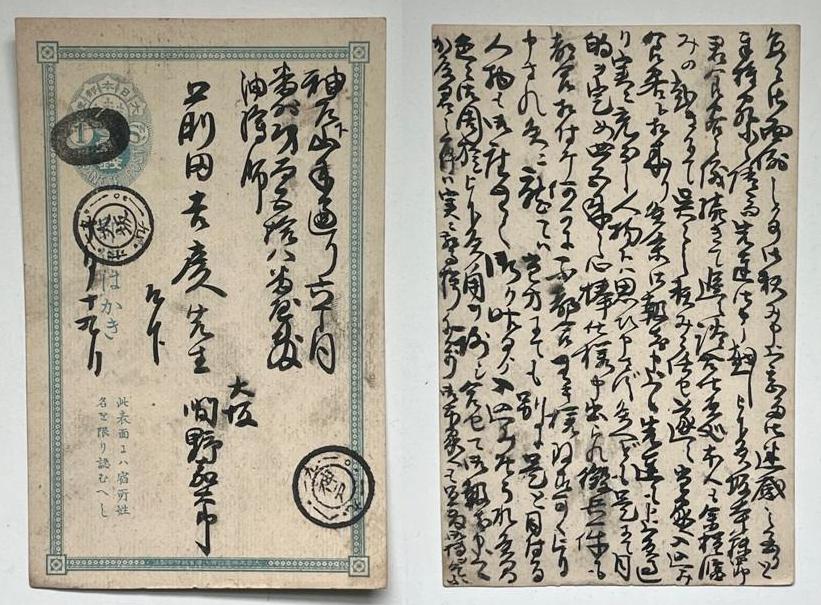
We have an intriguing set of three postcards here, all postmarked in Osaka in 1886, dated January 8, January 19, and July 31. The sender lists his return address as 大坂府土佐堀通り (Tosabori-Douri, Osaka).

召の茄太郎

The first postcard (see photo 1 above) provides our initial clue. The sender writes his name as 召の茄太郎, using the hiragana "の" (no) in place of the second character of his name. Based on this, we initially read the name as "Shouno Katarou."

召野茄太郎

The second postcard (see photo 2 above) offers a more standard version of his name: 召野茄太郎, where "野" replaces the hiragana "の." However, this card also includes a red ink stamp beneath his name. Unfortunately, the stamp is partially obscured by overlapping ink, making the characters difficult to decipher (see photo 3 below).

間野

The third postcard (see photo 4 below) adds a surprising twist. Here, the sender writes his name as 間野茄太郎 (Mano Katarou). This variation sheds light on the mystery of the red stamp—the first character might indeed be "間" (ma). It also suggests that "召," used on the first card, could have been a simplified or shorthand version of "間." 

間野茄太郎 (Mano Katarou)

These variations create a fascinating puzzle, one that offers us glimpses into how names were written and adapted at the time. While some questions remain unanswered, they provide an engaging challenge, allowing us to piece together fragments of history in the process.

The card dated July 31 (see photo 2) is addressed to three individuals: Maeda Yoshihiko (前田吉彦), Maeda Atsuo (前田農夫), and Udagawa Kingo (宇田川謹吾). In our post from November 16, 2024, we showcased another card with Udagawa Kingo (宇田川謹吾) as the recipient. While his identity remains unknown, the fact that he stayed at the Maeda residence on another occasion suggests he was likely someone close to the family.

Now we arrive at the intriguing question: who was Maeda Atsuo? Could he have been a relative of Maeda Yoshihiko? While Maeda is a common surname, the presence of another Maeda in the same household may not simply be a coincidence.

前田農夫 (Maeda Atsuo)

In the 大蔵省職員録 (Ministry of Finance Staff Directory, March 1877), Maeda Atsuo is listed as 士族岡山縣前田農夫 (Samurai from Okayama Prefecture). This detail is significant, as Maeda Yoshihiko was also from Okayama and of samurai heritage. These shared origins strongly suggest a familial connection between the two.

Furthermore, there is evidence linking Atsuo to the city of Kobe, where Yoshihiko taught art classes. Maeda Atsuo is mentioned in the 神戸権勢史 (History of Kobe's Influential Figures), further tying him to the same circles and locations as Yoshihiko. This overlapping context of geography, class, and activity strengthens the likelihood that their relationship was more than coincidental.

Friday, January 24, 2025

河合新蔵の父、河合栄七からのはがき

Kawai Eishichi (河合栄七)

I searched extensively for information on the family members of Kawai Shinzo, but such details seem to be nearly nonexistent, apart from brief mentions of his wife and two daughters. However, we believe this Kawai Eishichi (河合栄七) is Shinzo's father, based on the return address, Minami-honmachi, Osaka (大阪 南本町), which Shinzo frequently used. According to the National Diet Library Search, Eishichi is noted as having invested money in a business venture.

This postcard is postmarked August 3, 1889, in Settsu, Osaka. In it, Eishichi appears to consult Maeda about a matter involving Mr. Kuroda—most likely Kuroda Uhei (黒田夘兵衛) of Kure Shosha in Osaka (大坂呉商社), referenced in our post dated January 18, 2025. Eishichi describes the situation as challenging and emphasizes the need for careful deliberation. He also seeks Maeda’s insight, asking for his thoughts and guidance at the earliest opportunity.

While the exact subject matter remains unclear, it likely pertains to a business connected to art supplies, a field we believe Kuroda was involved in.

Wednesday, January 22, 2025

丸裁巻刀 Honsou (本惣) Maker Shibata Kita of Osaka 1886

丸裁巻刀 Maker Shibata Kita of Osaka 1886

Postmarked on August 11, 1886, in Osaka, this postcard provides a fascinating glimpse into the world of Meiji-era craftsmanship. The sender, Shibata Kita, was a specialist in precision cutting tools and operated out of Osaka Honmachi 1-chome, as indicated by the red return address stamp. Within the rectangular stamp is a small oval mark (本惠) that signifies his expertise in crafting “Marusai Bocho” (丸裁巻刀), a specialized blade designed for cutting washi, the Japanese rice paper used in woodblock printing and other artistic applications. These blades were also indispensable for cutting shoji paper, cloth, and other materials requiring precise cuts.

Marusai Bocho

This letter is likely a follow-up on an order Maeda placed for a Marusai Bocho. The phrasing, especially '如何相成候哉' (how is it working out for you?) and '早速にても御返事被下度候' (I would appreciate your reply as soon as possible), strongly suggests that Shibata Kita is seeking feedback regarding the order.


Monday, January 20, 2025

鈴木重持 Suzuki Shigemochi School Teacher


ecember 31, 1888, and January 3, 1889, in Kumamoto

鈴木重持 Suzuki Shigemochi School Teacher

Postmarked December 31, 1888, and January 3, 1889, in Kumamoto, these New Year’s cards were sent by Suzuki Shigemochi (鈴木重持), an educator who was likely once a student of Maeda. Why did Suzuki send two cards just days apart? He may have forgotten he had already sent one or was unsure if it had been mailed. Either way, the second card was likely sent out of caution or courtesy.