
Postmarked on January 2, 1890, and May 28, 1890, in 武蔵東京本所 (Musashi Tokyo Honjo), these cards were sent by 藤井忠弘 (Fujii Tadahiro). He is believed to have been an artist, specializing in illustration and cartography, active during the Meiji era.

Postmarked on January 2, 1890, and May 28, 1890, in 武蔵東京本所 (Musashi Tokyo Honjo), these cards were sent by 藤井忠弘 (Fujii Tadahiro). He is believed to have been an artist, specializing in illustration and cartography, active during the Meiji era.

This postal card was sent on January 5, 1889 from Utsunomiya, Tochigi by Iida Masanobu. It has the usual preprinted New Year's message along with handwritten note, which we are not able to read. Iida Masanobu was involved in the establishment of teacher training institutions to ensure that educators were well-prepared to teach the new curriculum. His work in this area helped professionalize teaching and elevate the status of educators in Japan.


This postcard was sent by Fujimoto Yasubei, a rice dealer from Kobe, on May 24, 1890. He is mentioned in the publication Hyogo-ken Jinbutsu-hyo (兵庫県人物評), which was released between 1892 and 1896. This work lists and describes the prominent figures of Hyogo Prefecture (see photo).


It is interesting to note here that Mori Kinseki (森琴石, 1843-1921), who studied Western-style painting like Maeda Yoshihiko, worked extensively with Hobunkan (宝文館 ほうぶんかん), providing illustrations for various publications. This partnership allowed his artwork to reach a broader audience, as Hobunkan was known for its wide distribution network and quality publications.

This New Year's greeting card was sent from Hiroshima on January 7, 1890, by Major Wachi Taiichirō of the Japanese Imperial Army Infantry. The message side is preprinted. He later achieved the rank of Colonel during his distinguished military career. In the National Diet Library of Japan database (https://dl.ndl.go.jp/pid/843147/1/54?keyword=和知泰一郎), Major Wachi is mentioned in the Imperial Military Literature, edited by Junichiro Suzuki and published in 1895 (see photo). This record shows that he communicated from the battlefield to assure his family of his safety and well-being.

For further details and related historical context, you can visit the following websites:
http://yutaka901.fc2web.com/page5dux12.html
https://tomura.lolipop.jp/9/3chuukonhi/28magameyamajinjagaisenhi.htm
Although Wachi Taiichirō was noteworthy, it was his son, Takaji Wachi (和知 鷹二, 1893–1978), who achieved significant historical prominence. Takaji Wachi rose to the rank of Lieutenant General during World War II, and his extensive biography is available online for those interested in learning more about his impactful career.
We do not know what the relationship between Maeda and Wachi was at this time. Perhaps more information will become available as we study this collection of postcards further.

This “in-care-of” stationery card, mailed from Minagi in Bichu on October 29, 1891, was addressed to a guest staying with Yoshihiko Maeda (前田吉彦) at Yamate-dori 6-chome (山手通 六丁目). The sender is Akagi Yoshihiko (see 4-17-25 post).


The more I research 富山芝人 (Toyama Shibahito) through this はがき collection, the more I uncover about his life, despite the information being quite fragmentary. He not only worked on an abridged translation of the book Russo-Turkish War Records (露土戦争記), published in 1878 (Meiji 11), but he also contributed to HIOGO NEWS and was actively involved in the tree nursery business in 神戸 (Kobe). We do not yet know whether 富山隆 (Toyama Takashi), who was also active in the nursery business, was the son, brother, or another relative of 芝人 (Shibahito).


The two cards we illustrate here (see above) further demonstrate that 富山芝人 (Toyama Shibahito) had a connection with HIOGO NEWS. One of these cards, a New Year's greeting dated 1885, was sent by Takaatsu Okazaki of Osaka (岡崎高厚 1853-1904, Freedom and People's Rights Movement Activist of the Meiji Era) and is simply addressed to Toyama at Hyogo News (兵庫ニュース). Another New Year's card from the same year, also originating from Osaka, addresses Toyama as 兵庫ニュース社長 (President of Hyogo News). We understand that HIOGO NEWS was a biweekly English newspaper based in Kobe (Hyogo), first published on April 23, 1868.


Furthermore, the Toyama family was involved in the plant nursery business, as evidenced by four illustrated cards that include the term "植木商" (Ueki-shō) in their address. This term refers to businesses engaged in the cultivation and sale of plants, trees, and shrubs, often focusing on ornamental or landscape plants. The dates on these cards are 1886, 1888, 1890, and one with an illegible postmark.


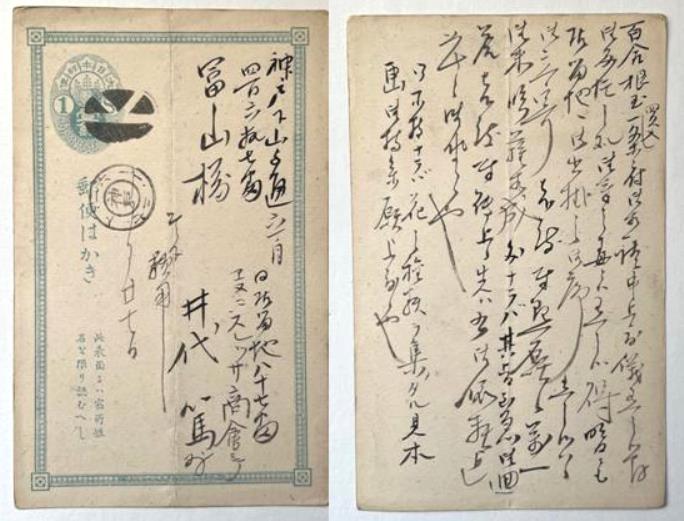
Additionally, although one card (see below) does not include "植木商" (Ueki-shō) in the address, it references lily bulbs in a message sent by 井代篤子 (Ishiro Atsuko) in 1883. Unfortunately, we could not find any information about her online.
Finally, we were able to confirm that 富山芝人 (Toyama Shibahito) is indeed the translator of Russo-Turkish War Records (露土戦争記). In the book, he is mentioned as having performed 抄訳 (しょうやく, shōyaku), which refers to a "summary translation" or "abridged translation." This process involves translating only the essential parts or main points of a document rather than providing a verbatim translation. His name and address are clearly indicated in the book (see photos).


When we posted about the famous peonies (see October 16 post), known as "Kiksuke peonies," featured in One Hundred Views of Osaka, we had no idea how crucial a role Toyama would play in our subsequent posts. We do not yet know how he is related to Maeda Yoshihiko, but they were neighbors in Kobe. We hope to uncover more as this blog progresses.
Although post titles will remain in Japanese, descriptions will be in English going forward, as writing in Japanese requires too much effort. My eyes and brain would be overwhelmed if I kept it up. Moreover, with hundreds of these postcards to investigate, time is limited.

このはがきは前田吉彦に送られた黒の背景に赤文字で書かれたものにとてもよく似ています (10月7日の投稿参照)。ただし、これら二つのはがきは異なる個人から送られたものです。このはがきは、神戸の冨山柴人宛てで、大阪川口から明治23年8月20日に送られました。送信者とメッセージの内容は判読できません。他に同じようなはがきをご存知の方はいらっしゃいますか?
This postcard is very similar to the one sent to Maeda Yoshihiko, which was written in red letters on a black background (see the October 7 post). However, these two postcards were sent by different individuals. This postcard was addressed to Tomiyama Shibito in Kobe and sent from Kawaguchi, Osaka, on August 20, 1890 (Meiji 23). The sender and the content of the message are unreadable. Does anyone know of similar postcards?